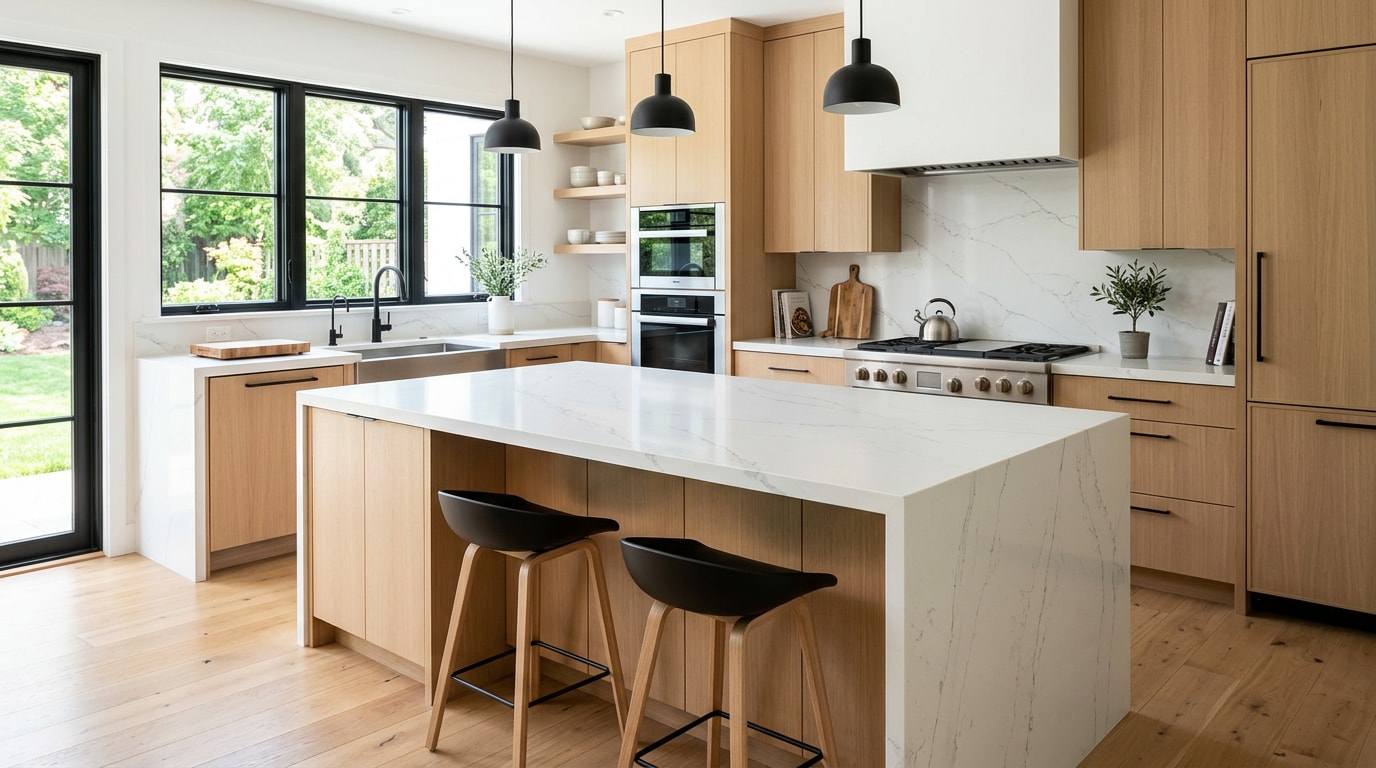
Porcelain countertops cost Lake Elmo, MN homeowners roughly $60 to $150 per square foot installed, with premium slabs reaching $200. For a typical 35-square-foot kitchen, that puts most projects between $2,100 and $5,250 installed. This guide breaks down exactly where that money goes, so you can read a fabricator's quote and know what's fair.
Porcelain Countertop Cost Per Square Foot in Lake Elmo, MN
Most fabricators price porcelain between $60 and $150 per square foot installed. Budget tile-based jobs start closer to $40 per square foot. Premium large-format imported slabs with mitered edges can top $200 per square foot.
That range covers both material and labor, the two line items every honest quote should break out separately.
Most kitchens in the Lake Elmo area have 30 to 40 square feet of counter space, including an island. At that size, a mid-range porcelain project typically lands between $3,000 and $5,500 installed. High-end imported slabs or waterfall-edge islands can push the total toward $7,000 or more.
| Tier | Cost per Sq. Ft. (Installed) | Typical 35 Sq. Ft. Kitchen |
|---|---|---|
| Budget | $40–$70 | $1,400–$2,450 |
| Mid-range | $75–$130 | $2,625–$4,550 |
| Premium | $140–$200+ | $4,900–$7,000+ |
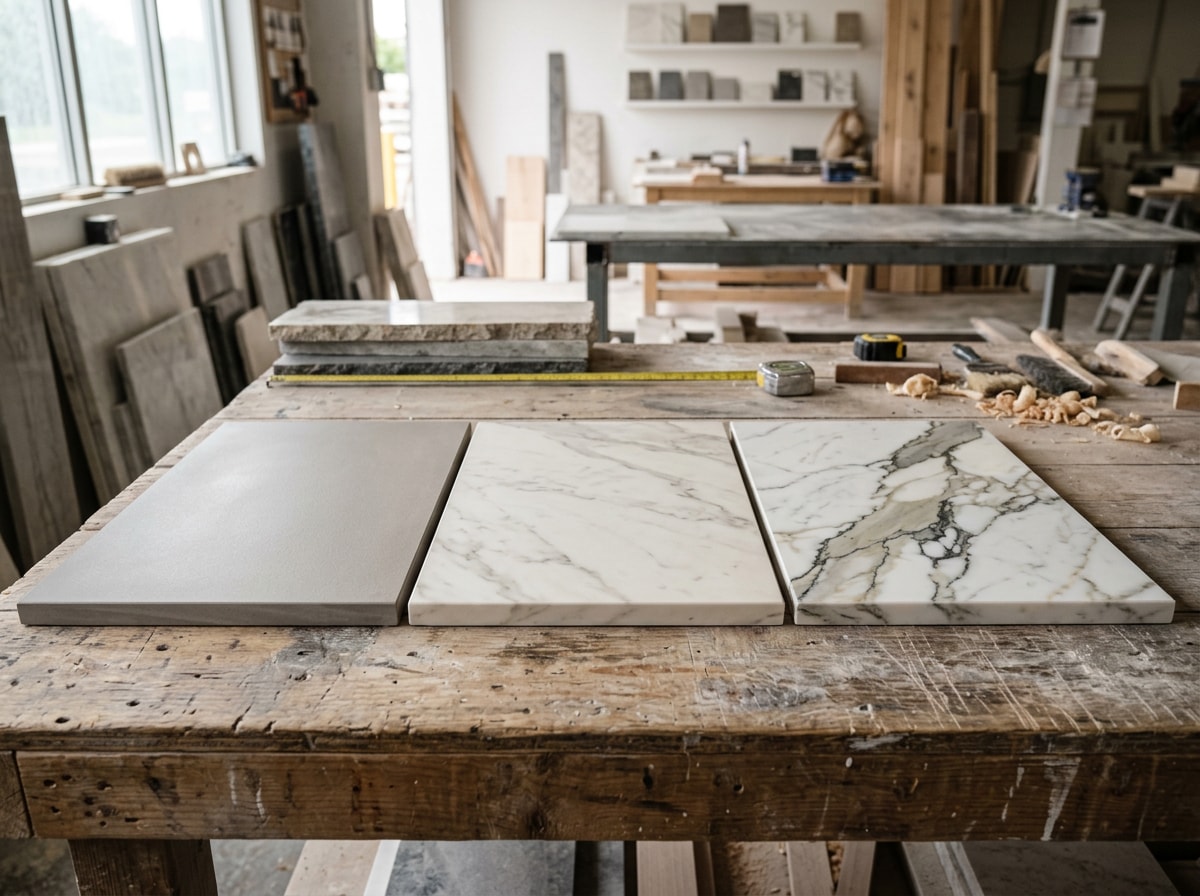
See current pricing and finish options on our countertop installation page.
What Drives Porcelain Countertop Cost
A handful of variables move porcelain pricing more than homeowners expect: slab versus tile format, total square footage, material grade, and edge profile. Knowing these ahead of time makes it much easier to compare quotes from different fabricators.
Porcelain Slab vs. Porcelain Tile
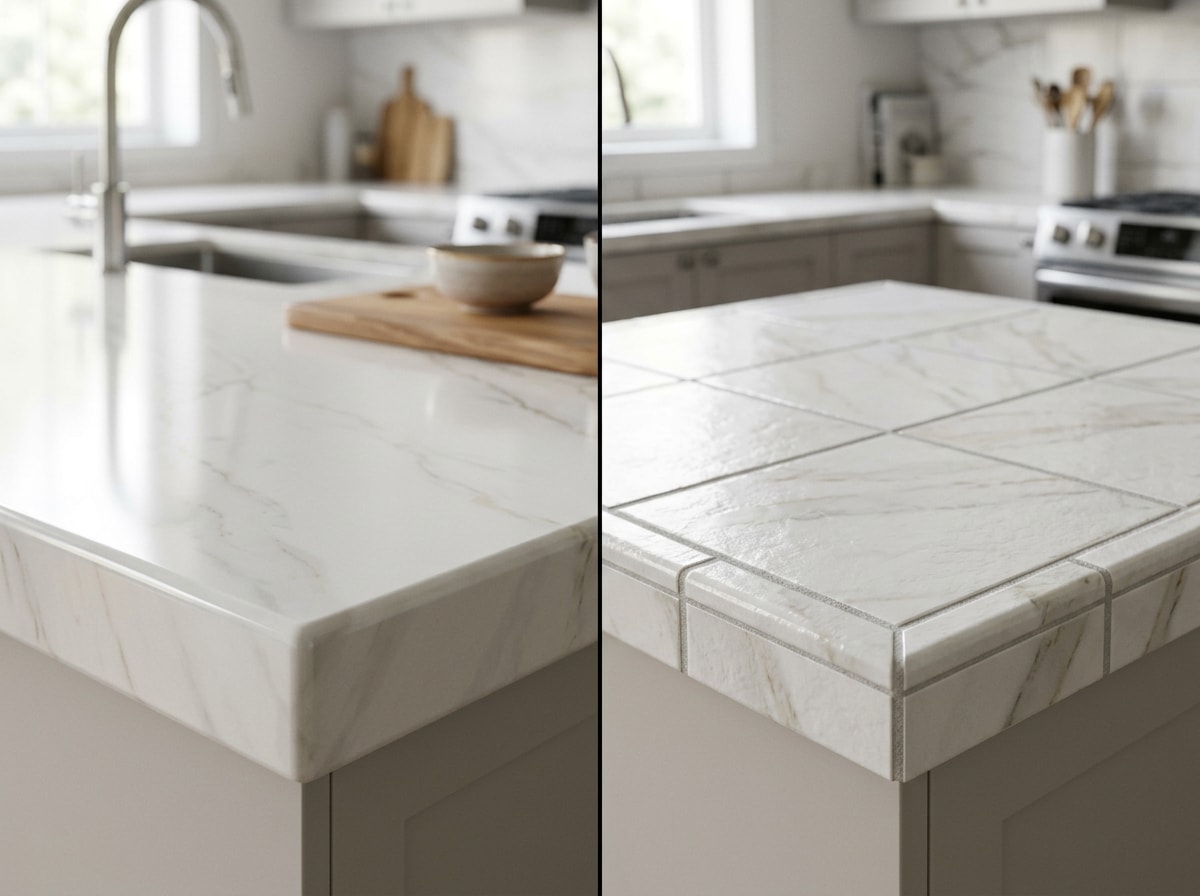
Slab costs more than tile because the two materials are fabricated differently. Tile installs like any standard tile job. Slab requires diamond-blade cutting, careful handling, and precise seam work.
Porcelain tile typically runs $15 to $50 per square foot installed. Full slab installations run $60 to $200 or more per square foot, depending on size and edge detail.
Slab also delivers a seamless look with far fewer grout lines to maintain, which is why most kitchen remodels lean toward slab despite the price gap.
Porcelain's classification isn't a marketing term, it's a technical standard. It is especially critical that water absorption be accurately determined per C373, as it is the determining factor for whether a ceramic tile is considered porcelain or not, and only tiles with water absorption of 0.5% or less, when tested per C373, can be deemed porcelain by the Porcelain Tile Certification Agency (PTCA) , according to ASTM International.
Size
Total square footage is the single biggest multiplier on your final bill, since fabricators price per square foot. A compact 25-square-foot kitchen always costs less in raw material than a 50-square-foot layout with a large island, even at the same per-square-foot rate.
Size also affects slab yield. Fabricators need to account for waste when cutting around sinks and cooktops, so larger kitchens or waterfall-edge islands often require more than one slab.
Material Grade
Porcelain slab material, separate from labor, generally falls between $25 and $65 per square foot before fabrication. Higher-end imported slabs with bold veining or large-format panels sit at the top of that range, while domestic or mid-tier porcelain stays closer to the bottom.
This material price is just the raw slab. It doesn't include cutting, edge work, sink cutouts, or installation labor.
Edge Profile
Edge choice can add a few hundred dollars to a project, or very little:
- Eased or square edge: usually included in the base price
- Bullnose edge: typically adds $10 to $20 per linear foot
- Mitered or built-up edge: can add $40 to $80 per linear foot, since it doubles the slab thickness for a heavier look
Porcelain slabs run noticeably thinner than natural stone, which limits how many heavier edge treatments a fabricator can safely offer compared to granite or marble.
Labor Cost to Install Porcelain Countertops
Labor and fabrication typically account for $40 to $90 per square foot of the installed price, often making up a larger share of the bill than the material itself.
The reason comes down to the material's physical properties. Porcelain is thin, dense, and brittle during cutting, so fabricators need diamond-tipped tools, careful handling, and extra time to avoid cracking a slab mid-cut. A broken slab means reordering material, so shops build that risk into labor pricing.
The median annual wage for flooring installers and tile and stone setters was $52,000 in May 2024 , per the U.S. Bureau of Labor Statistics. That skilled-trade wage is part of why fabrication, not material, is usually the biggest line item on a porcelain quote.
Pros and Cons of Porcelain Countertops
Pros:
- Non-porous, resists staining without sealing
- Highly heat resistant, hot pans generally won't scorch the surface
- UV stable, holds color better than quartz in sun-exposed spots
- Scratch resistant due to its dense, kiln-fired body
Cons:
- Harder to cut than quartz or granite, which drives up labor cost
- Brittle at thin edges, so shipping and handling carry more breakage risk
- Fewer fabricators specialize in porcelain than in granite or quartz, which can mean longer lead times
Over a 15- to 20-year ownership period, porcelain's durability and lack of ongoing maintenance often offset its higher upfront fabrication cost. Homeowners in our Lake Elmo service area frequently choose it for exactly this long-term value tradeoff.
Porcelain vs. Quartz vs. Granite: Which Costs More?
Porcelain sits in a middle tier of countertop investment: pricier than laminate or butcher block, but often comparable to quartz, while requiring less upkeep than granite.
| Material | Installed Cost (per sq ft) | Typical Lifespan | Sealing Needed |
|---|---|---|---|
| Porcelain | $60–$200+ | 25+ years | No |
| Quartz | $50–$150 | 20–25 years | No |
| Granite | $45–$130 | 20+ years | Yes, periodic |
| Butcher Block | $40–$100 | 10–20 years | No (needs oiling instead) |
The maintenance gap is real, not marketing spin. Quartz is actually a manufactured product made of quartz stone and a synthetic polymer and does not require sealing , while granite countertops need to be sealed several times a year , according to Iowa State University Extension and Outreach. Porcelain shares quartz's no-sealing advantage, but handles heat and sun exposure better than either stone.
Using the midpoint of each range on a 35-square-foot kitchen as a rough illustration: porcelain lands around $4,550, quartz around $3,500, granite around $3,000, and butcher block around $2,450. Porcelain and quartz often end up in the same bracket, with fabrication lead time and slab availability deciding the winner more than price.
If new counters are part of a bigger overhaul, our kitchen remodeling team can coordinate cabinets, layout changes, and countertops as one project. Browse finished installations on our projects page.
Why Lake Elmo Homeowners Choose Porcelain
Minnesota's freeze-thaw winters and intense summer sun make outdoor counter surfaces tricky. Porcelain's near-zero water absorption and UV stability make it one of the few materials we'll install on an exposed grill station or four-season porch counter without worrying about frost cracking or sun fading.
Pairing new counters with refreshed cabinetry is one of the most requested upgrades we see locally. See our guide to before-and-after cabinet refacing in Lake Elmo for ideas on pairing the two.
Ready for exact numbers on your kitchen? Get a free estimate and we'll measure your space and quote porcelain, quartz, and granite side by side.
FAQ
What Is the Average Cost to Install Porcelain Countertops in a Kitchen?
For a standard 30- to 40-square-foot kitchen, total installed cost typically falls between $2,500 and $6,500, with most Twin Cities projects landing near $4,000. The final number depends on slab grade, edge profile, and how many sink or cooktop cutouts the layout needs.
Is Porcelain Cheaper Than Quartz for Countertops?
It depends on the tier. Entry-level porcelain tile, at $15 to $50 per square foot, is cheaper than quartz. Premium porcelain slab, at $140 to $200+ per square foot, often lands in the same range as quartz or slightly above it, so porcelain isn't automatically the budget option.
Does Porcelain Countertop Installation Cost More Than Granite?
At the low end, granite can be cheaper, starting around $45 per square foot versus porcelain's roughly $60 floor. At the high end, pricing is comparable, with both materials reaching $150 to $200+ per square foot for premium slabs and complex fabrication.
Do Porcelain Countertops Need to Be Sealed?
No. Porcelain's near-zero water absorption means it never needs sealing. That's a real advantage over granite, which most manufacturers recommend resealing periodically to maintain stain resistance.
How Does Porcelain Compare to Quartzite in Cost?
Quartzite typically installs for $70 to $200+ per square foot, which overlaps heavily with porcelain's range. The choice usually comes down to look and maintenance tolerance rather than price, since quartzite needs periodic sealing and porcelain does not.
About This Guide
This pricing guide was put together by the BRZ Construction team, a licensed, insured general contractor serving Lake Elmo, Stillwater, Woodbury, and the surrounding Twin Cities area. Our crews install porcelain, quartz, and granite countertops as part of full kitchen remodels, and the ranges above reflect what we're actually quoting on local jobs, not just national averages. Have a specific kitchen in mind? Contact BRZ Construction for a free walkthrough, or learn more about our company on the BRZ Construction homepage.